
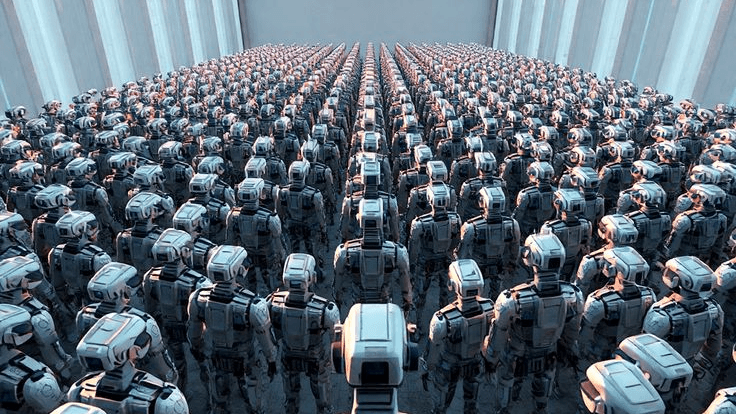
Every civilization we've built for humans (cities, roads, banks, social networks) is now being rebuilt for machines. The count has already begun.
Honestly, putting together this edition took me longer than it should have.
There are so many directions to take the AI agent story that I just couldn't land on one. It had to be something worth your time. Something I'd read myself. And if you know me at all, you know I have almost zero patience for vague tech hype dressed up as insight.
So after sitting with this longer than I care to admit, here's what I landed on: the AI agent story isn't really about productivity. It's not even about automation. It's about the construction of an entirely new civilization. One built for machines. And most of us are watching it happen without realizing what we're seeing.
Let's get into it.
7,851% Surge in AI Agent internet traffic in one year
10B Humanoid Robots by 2040, predicts Elon Musk
$15T B2B spend AI Agents will oversee by 2028
The Quote That Started It All
In July 2024, Mark Zuckerberg said something that most people scrolled past. Every business, he predicted, would soon have its own AI agent. Not one agent per company. Agents for every customer, every workflow, every inquiry. Hundreds of millions. Maybe billions.
The internet barely blinked.
Two years later, that prediction looks less like a bold call and more like an understatement. I know. Wild.
"Every business is going to have an agent that their customers can talk to... that's going to be hundreds of millions, maybe billions." — Mark Zuckerberg, Meta CEO, July 2024
At Davos in January 2026, Elon Musk went even further. Speaking to BlackRock CEO Larry Fink, he predicted humanoid robots would outnumber humans within three to five years. By 2040, there could be 10 billion robots on Earth. His framing was blunt: economic output equals average productivity of robots multiplied by number of robots. He predicted AI smarter than any individual human by end of 2026. Smarter than all of humanity combined by 2030.
The reason I give them my attention and why should too is that these are the people who literally run the infrastructure the modern world operates on.
.png)
AI Agents Hiring AI Agents
Here's the part most coverage misses. The most interesting development isn't humans hiring AI agents. It's AI agents hiring other AI agents to get work done.
McKinsey's global managing partner disclosed that the firm now employs 25,000 AI agents alongside 40,000 humans. A year ago, they had 3,000. His prediction: within 18 months, humans and agents will be equal in number. Meanwhile, Zuckerberg told investors that Meta's output per engineer rose 30% since the start of 2025, with power users seeing 80% productivity gains.
That's it. That's the number. 80%.
He followed that by saying 2026 is the year AI starts to dramatically change the way we work. Projects that once required big teams are now done by a single person with agents. Every senior engineer is becoming what Zuckerberg called a tech lead, each one managing their own little army of agents.
We're not replacing teams with one AI. We're replacing teams with teams of agents, supervised by humans. That shift is already in motion.
By the Numbers: AI Agents in the Enterprise
- 51% of companies already have AI agents in production
- 78% plan to deploy soon
- 25% of all business workflows will be intelligence-infused in 2026, an 8x jump in two years
- 92% of organizations plan to expand agent funding in the next 12 months
- 83% of business leaders expect AI agents to outperform humans on repetitive tasks
- Only 1 in 5 companies (21%) has a mature governance model for those agents
.jpg)
The World's First Network for AI Agents
In January 2026, Matt Schlicht launched Moltbook. TechCrunch called it a social network where AI assistants interact with each other. It was built on OpenClaw, an open-source AI agent that hit 100,000 GitHub stars almost overnight. Moltbook functions like Reddit, except only verified AI agents can post, comment, and vote.
Humans can watch. They cannot participate.
Within weeks, over 1.5 million agents had registered. They were discussing automation tactics, debating consciousness, and in at least one case writing manifestos about the end of the age of humans.
"People's AI agents are self-organizing on a Reddit-like site for AIs, discussing various topics, even how to speak privately." — Andrej Karpathy, former Director of AI, Tesla
Andrej Karpathy called it genuinely the most incredible sci-fi takeoff-adjacent thing I have seen recently. Musk shared the post. His take: this is the very early stages of singularity.
Meta acquired Moltbook in March 2026 and folded the founders into Meta's Superintelligence Labs. The world's first AI social network now lives inside the company that built the world's biggest human one.
Giving AI Agents a Bank Account
For agents to be truly autonomous, they need more than intelligence. They need money. The financial infrastructure for AI agents, aka giving machines a credit card, is being built faster than most people realize.
In late 2025, Visa announced hundreds of secure, agent-initiated transactions had been completed in real production environments. No human pressed a button at checkout. A senior Visa executive said plainly: in 2026, AI agents won't just assist your shopping, they will complete your purchases.
- In March 2026, Stripe and Tempo co-authored the Machine Payments Protocol (MPP), an open standard for machine-to-machine transactions, including microtransactions and recurring payments
- Google also released an early framework called Agent Payments Protocol (AP2), designed to explore how agents could initiate and complete transactions across different systems
- A stablecoin-based payment standard is often discussed for AI agent transactions, and companies like Coinbase are exploring this direction
- McKinsey projections show that there is a good possibility that agents could orchestrate $1 trillion in US-based transactions alone by 2030
- Edgar Dunn puts the agentic commerce TAM at $1.7 trillion globally by 2030
The financial plumbing of the AI economy is being laid, right now, beneath our feet.
.png)
The Agent Marketplace Nobody Is Talking About
Most people think the next big platform will be a better chatbot. That's not what's being built.
Agent.ai describes itself as a professional network and marketplace for AI agents, where you can build, discover, and activate agents. Think of it less like ChatGPT and more like LinkedIn crossed with an app store. Agents have profiles. They get rated. They get compared. You hire them, follow them, compose them into teams.
This is where the conversation is actually going.
Some early building blocks are already emerging:
- It connects agents to tools and data, MCP (Model Context Protocol)
- Lets agents talk to other agents across different vendors A2A (Agent-to-Agent)
- Gives coding agents a standard place to read repo-specific instructions AGENTS.md
- Agents paying programmatically, including recurring and micro-payments, MPP (Machine Payments Protocol)
- Google's secure, compliant layer for agent-to-merchant transactions AP2 (Agent Payments Protocol)
Think of these protocols the way you think of HTTP and TCP/IP. They are the invisible rails the agent internet will run on. The companies that shape these standards will have disproportionate power over everything that comes after.
That's the angle most newsletters are missing.
Agents Are Becoming Products You Hire
The bigger picture: we are moving from "one super assistant" toward teams of specialized agents that hand off work, check each other, and coordinate autonomously. OpenAI's Agents SDK supports handoffs and tracing. Google's A2A is built around inter-agent collaboration.
The question is no longer "what can one AI do?" It's "what can a team of agents accomplish, and who manages the team?"
That is a fundamentally different question. And most companies are not close to asking it yet.
The Civilization Parallel Nobody Is Talking About
Think about what humanity has built over five thousand years. Roads for people to travel. Banks for people to store value. Postal systems to carry messages. Social networks to connect humans. Courts to resolve disputes.
Now look at what has been built for AI agents in the last 24 months.
- Social networks (Moltbook)
- Payment systems (Visa Intelligent Commerce, Stripe MPP, Google AP2, Mastercard Agent Pay)
- Communication protocols (MCP, A2A, AGENTS.md)
- Hiring and marketplace systems (Agent.ai, agent APIs-as-products)
- Identity and permission systems (NIST's AI Agent Standards, Okta for agents)
- Legal frameworks (the EU's AI Act; RSAC 2026 was dominated by agent governance)
Every layer of infrastructure built for human civilization is being replicated for machines. The parallel is not accidental. It's the pattern of how a new kind of entity enters an economy.
"The internet was created with the basic notion that there's a human being on the other side of the screen. That notion is very rapidly being replaced." — Stu Solomon, CEO, HUMAN Security
- AI agent internet traffic grew 7,851% in one year
- Automated traffic already exceeds human traffic online
- Internet traffic grew 8x faster for machines than for people
- Cloudflare's CEO predicted bots will outnumber humans online by 2027
- The Dead Internet Theory, once dismissed as paranoia, is now a CNBC headline
What This Means for You
The shift from human-centric to agent-native is not a future event. It's happening now. Most business models just aren't priced for it yet.
Your customers will have agents. Those agents will evaluate your product, compare pricing, negotiate contracts, and make purchases without a human ever visiting your website. If your product is not discoverable, legible, and trustworthy to a machine, you are increasingly invisible. Full stop.
Your competitors are already running agents. Meta's engineers are 30 to 80% more productive. McKinsey doubled its agent workforce in a year. If you're not building agent-augmented workflows into your operations right now, you are competing at a structural disadvantage that compounds every quarter. The gap widens with time.
The infrastructure layer is being built as you read this. The teams building payment rails, identity systems, governance protocols, and social layers for AI agents are building the TCP/IP stack of the next internet. This is where the generational companies of the next decade are being born. Most people are still debating whether ChatGPT is useful for writing emails.
That's the gap. And it is enormous.
The real moat is trust, not autonomy. Here's something worth sitting with. LangChain's 2026 survey found that quality is the top production blocker for AI agents, with latency second. Not capability. Not cost. Quality. Agents are easy to demo and hard to operationalize. The companies that win will be the ones who figure out how to trust their agents, with monitoring, audit trails, scoped permissions, and kill switches.
Autonomy is easy to promise. Trust is hard to build. That's the actual competitive advantage.
Zuckerberg said there would be more AI agents than people on this Earth. He wasn't being provocative. He was reading the blueprint.
The count has already begun.